108th Edition — September 30, 2026
News from the projects
RNO-G
(submitted by Anna Nelles)
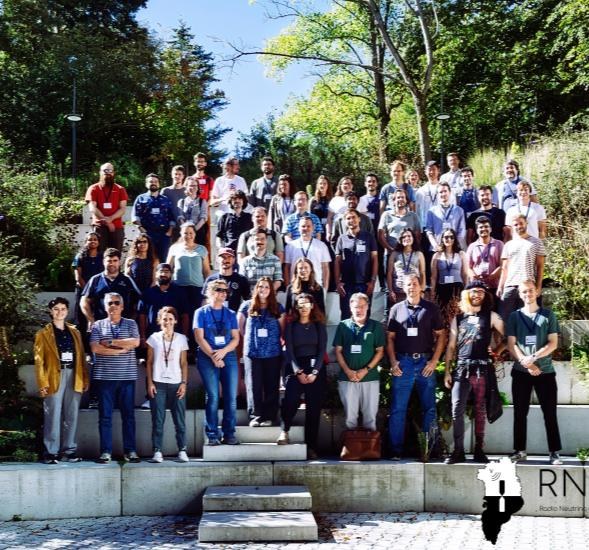
RNO-G met for the annual collaboration meeting in Brussels hosted by Simona Toscano, who is also the newly elected chair of the executive board. She replaces Nick van Eijndhoven who will retire before the end of this year. Nick has paved the way for RNO-G with securing significant funds from the FWO, but most importantly his eternal optimism that things will work, if one just continues to try. The collaboration dinner was held in Nick’s honor, given that his speeches always were a highlight every year, celebrating accomplishments and making grand plans. The new RNO-G leadership is completed with Steph Wissel as US PI and Anna Nelles as EU PI. During the meeting many students presented their ongoing work and upcoming paper drafts, making the discussions lively and forward-looking. As RNO-G is entering its 6th year since inception, a large cohort of PhD students has graduated this year, marking the path of RNO-G from early commissioning data into more mature data taking.
While writing this report, the RNO-G stations are enjoying their last days of data taking with the Sun rising shorter and shorter above the horizon in Greenland. A new set of wind-turbines sporting new cold temperature lubricants and different geometries will ideally extend life-time during the dark months. A new industrial device will monitor ice formation and icing conditions, hopefully helping in understanding how wind-turbines can be made more reliable for in-winter operation.
KM3NeT: Welcome ARCA 62!
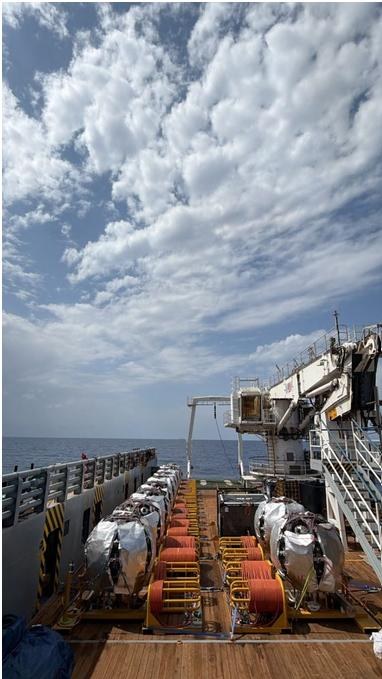
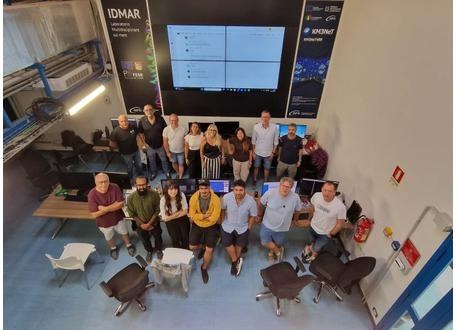
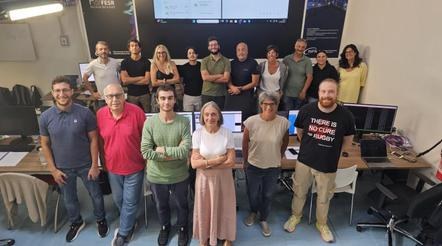
Between September 4 and September 20, a sea campaign was conducted at the KM3NeT ARCA site. The campaign led to a significant step forward in the construction of the apparatus, including an enlargement of the submarine infrastructure and the detector and an upgrade of its acoustic positioning system.
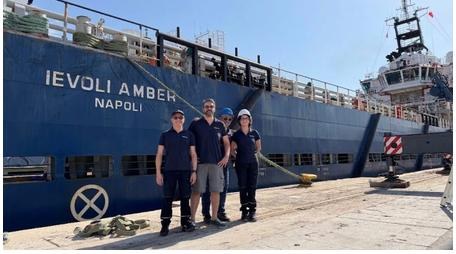
The operation was carried out in two hitches, sailing from Malta. The ship was the Ievoli Amber, equipped with a work-class deep-sea Remotely Operated Vehicle. It is operated by NGS (Next Geo Solutions) and was at its first service for KM3NeT.
The operation started with the deployment of two submarine junction boxes and four interlink cables, two for each junction box, and their connection to the sea-floor network, in preparation for the further expansion of the infrastructure. A dozen detection units were installed, one of them replacing a non-functional detection unit installed earlier. For each of them this operation implied: deployment with a precise positioning on the sea bottom, connection to the junction box and unfurling, with detailed inspections and functional tests carried out before and after unfurling. All Digital Optical Modules were found operational after installation. An inspection of the submarine infrastructure and an upgrade of the acoustic positioning system with the installation of two additional emitters and precise measurements of their positions were also performed.
The weather was far from ideal for part of the time, requiring several rearrangements of the planning throughout the operation. Overall, this operation has set a new record of efficiency for KM3NeT, leading to an ARCA detector which now includes 62 detection units, connected to shore through a network comprising two long-distance electro-optical cables and seven submarine junction boxes. A further sea operation is planned for the end of September, in order to deploy Cable Termination Frame 3 (CTF3), which will service the second building block of ARCA.
IceCube
IceCube 15-year Symposium in Chiba: On September 10, we celebrated 15 years of IceCube with a symposium in Chiba, Japan. While we spent some time reflecting on the research accomplishments, we were also eagerly looking forward to new data from the Upgrade and the potential of Gen2. The program from the symposium can be found here: https://indico-icehap.phys.s.chiba-u.ac.jp/event/10/
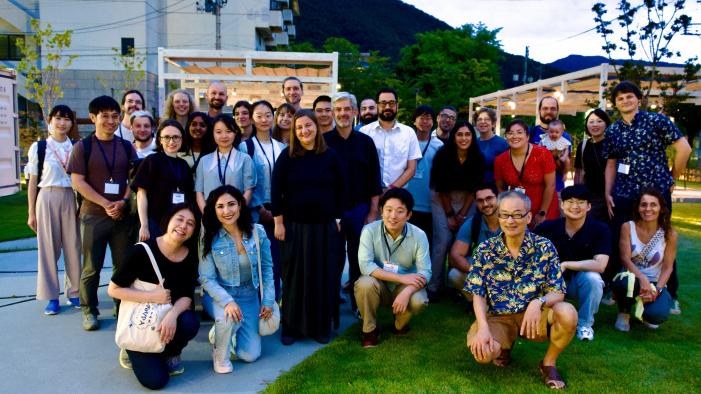
IceCube at TeVPA: Many IceCubers converged in Tendo, a beautiful onsen town in Japan for the TeV Particle Astrophysics 2026 conference (https://indico-icehap.phys.s.chiba-u.ac.jp/event/3/). There were over 25 presentations on IceCube and we enjoyed some social time together at an IceCube BBQ party (see photo). We are already looking forward to TeVPA 2027, which will be in Madison, USA.
(submitted by Erin Sullivan)
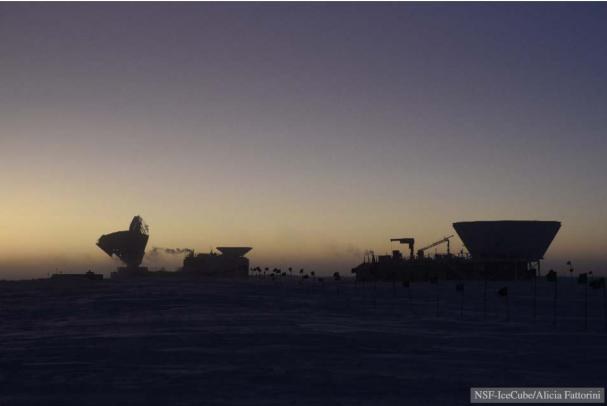
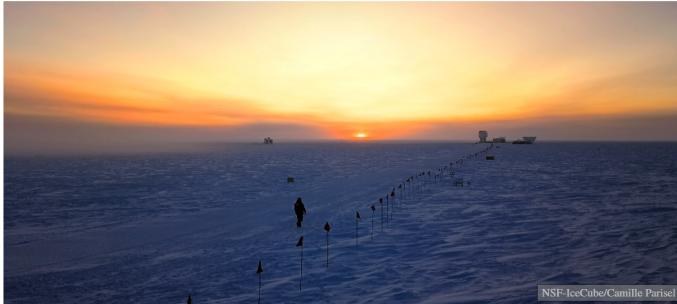
Sunrise at the South Pole: Winterover Alicia Fattorini sends another bunch of pictures, here are two of them, taken shortly before sunrise.

Publications
The IceCube Collaboration has posted four new papers on arXiv:
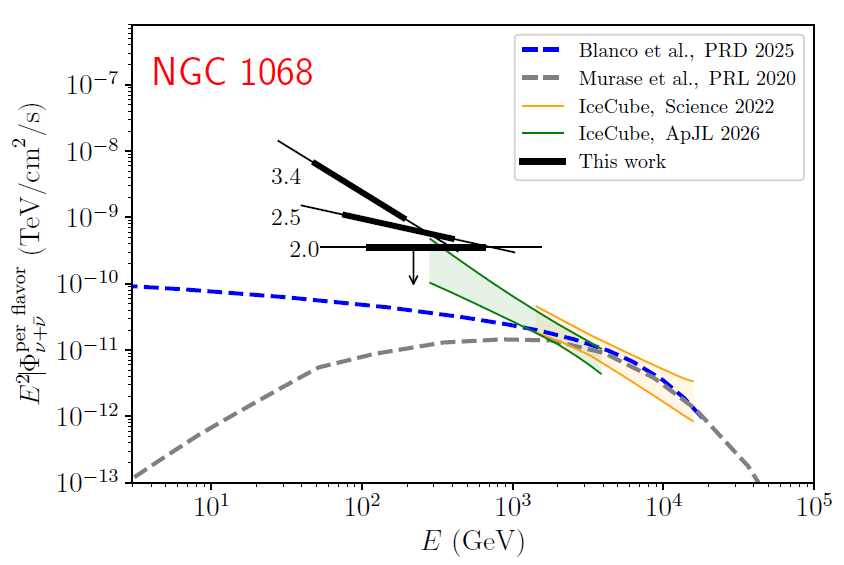
Time-Integrated Searches for Sub-TeV Neutrino Sources with IceCube-DeepCore (submitted to ApJL, posted at https://arxiv.org/pdf/2609.10931). The main authors are Andrew Wang (Georgia Tech. Univ.)
ABSTRACT
We have developed techniques for a competitive sub-TeV time-integrated neutrino search and applied it to 11.1 years of IceCube-DeepCore data. The DeepCore subarray lowers the sensitivity of IceCube down to sub-TeV energies and is especially interesting for objects with soft spectra. Three studies were performed: a search for neutrino emission from AGN exhibiting high intrinsic X-ray flux, including NGC 1068, as identified by SWIFT/BAT; a search for neutrino emission from Galactic objects identified by Fermi-LAT as exhibiting a spectral shape consistent with neutral pion decay; and an all-sky search for neutrino point sources. Objects for this study were selected given their prospects for sub-TeV neutrino emission. No evidence for sub-TeV neutrino emission is found in any of the searches performed. Finally, for each catalog of objects, we use a statistical combination of the p-values via a binomial test to search for aggregated neutrino emission from a subset of the objects. Neither of the binomial tests yields significant results. For NGC 1068, assuming a power law spectrum with index 3.4, the 90% confidence level upper limit on per-flavor neutrino emission in the 30–400 GeV range is Fν+ν̄|1TeV < 9.5 × 10⁻¹¹ TeV⁻¹ cm⁻² s⁻¹, a factor of two higher than the extrapolation of IceCube’s measurement at higher energies. We additionally provide neutrino flux upper limits for a variety of spectra.
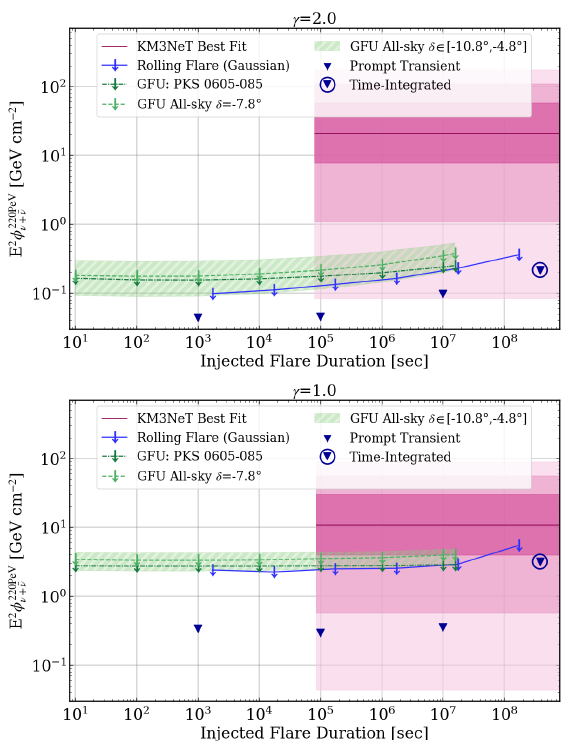
IceCube neutrino point-source searches in the direction of the KM3NeT ultra-high-energy event (submitted to PRL , posted at https://arxiv.org/pdf/2609.12055). The leading authors are Sarah Mancina (Univ. Padova), Alicia Mand (UW Madison) and Riya Shah (Drexel Univ.).
ABSTRACT:
While still under construction, the KM3NeT-ARCA detector recorded a ∼200 PeV neutrino on February 13th, 2023. This event is the highest energy neutrino reported. IceCube, a cubic kilometer neutrino detector located at the geographic South Pole, has previously detected neutrinos up to approximately 10 PeV. We search for high energy neutrinos from the location of the KM3NeT event using 15 years of IceCube data and considering three temporal hypotheses: steady or flaring in time coincidence, or at an arbitrary time. We find no evidence for neutrino emission for any of the studies performed. Correspondingly, we set upper limits on the neutrino flux from a point source in the direction of KM3-230213A. We compare these limits to KM3NeT’s estimated flux and show that an astrophysical explanation of this event is strongly constrained for a variety of spectral assumptions for a steady or transient point source with the flux inferred from the single KM3NeT ultra-high-energy event assuming a spectral index of 2.0.
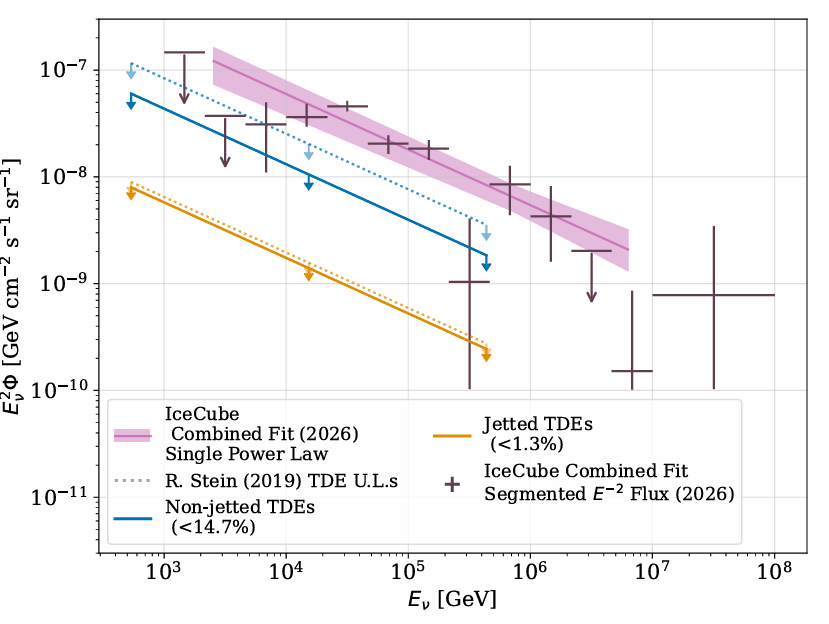
Search for Neutrinos from Tidal Disruption Events with IceCube (submitted to ApJL, posted at https://arxiv.org/pdf/2609.00657. Main author is Shannon Gray (Univ. Maryland)
ABSTRACT
Tidal disruption events (TDEs) are theorized to produce high-energy neutrinos through photo hadronic interactions between accelerated protons and multi-wavelength photons in the accretion disk and outflows. Detecting these neutrinos would provide insight into the dynamics of TDEs. Taking advantage of the recent increase in observed TDEs from wide field-of-view telescopes, we conduct a dedicated search for neutrinos coincident in optical/UV and X-ray wavelengths. We searched for neutrino emission from 89 TDEs selected based on X-ray and optical/UV observations using time dependent likelihood analysis methods in two parts. First, we searched for emission from individual sources, where we fit the time window of expected neutrino emission. Second, we performed a study of jetted and non-jetted TDE subpopulations using a stacking search with a fixed one-year time window. No significant neutrino excess was observed in either search. We set upper limits to the contribution of jetted and non-jetted TDEs detected in optical/UV and X-ray wavelengths to the diffuse astrophysical neutrino flux assuming TDEs are standard candles.
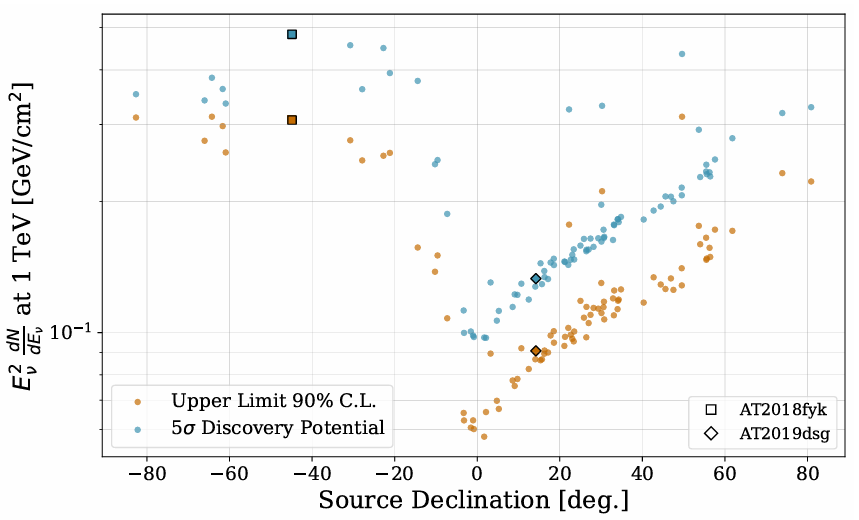
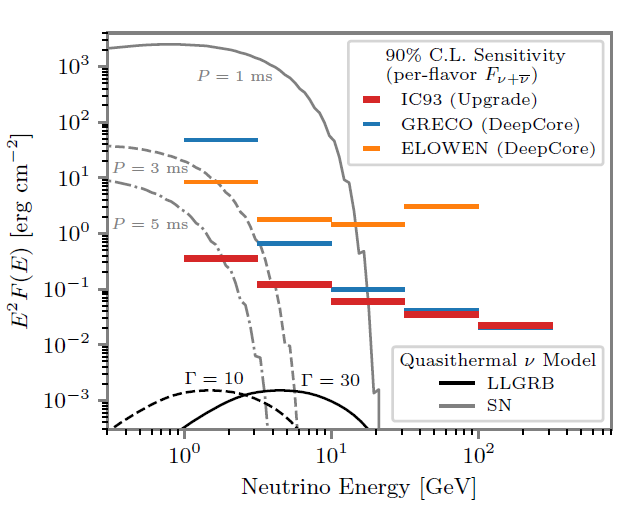
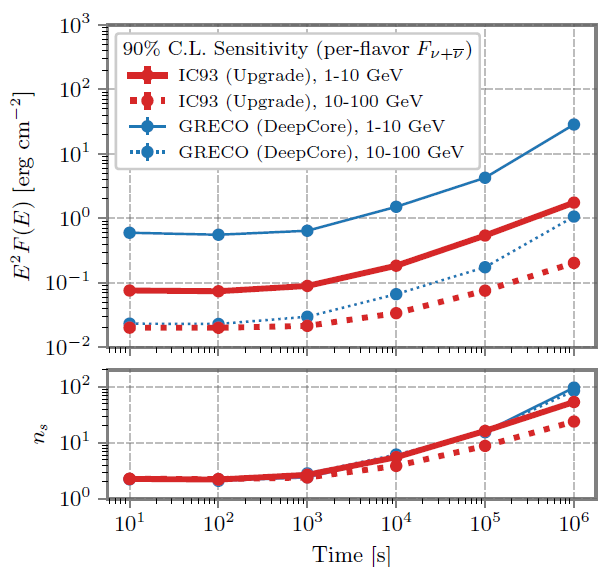
Astrophysical Sensitivity Projections for the IceCube Upgrade (submitted to Phys.Rev. D, posted at https://arxiv.org/pdf/2608.28395). Main authors are Markus Dittmer (Univ. Münster), Yukiho Kobayashi (Chiba Univ.) and Berit Schlüter (Univ. Münster).
ABSTRACT
… The IceCube extension installed in 2025/2026 introduces densely instrumented multi-PMT optical modules within the existing infill array known as IceCube DeepCore. It is expected to enhance sensitivity in the GeV regime, with commissioning of the detector expected to be complete by the end of 2026. We present the projected sensitivities of the IceCube Upgrade for three key analyses: neutrino transient searches, steady emission from point sources such as NGC 1068, and diffuse emission from the MilkyWay. These case studies represent direct extensions of current IceCube analyses. Using new Monte Carlo datasets, we demonstrate that the IceCube Upgrade achieves order-of- magnitude improvement in sensitivity at low energies (≲ 10 GeV) for time-dependent sources across short timescales. Conversely, for time-independent searches, the relative impact of the Ice-Cube Upgrade’s low-energy data is diluted by the decade-long accumulation of high-energy archival data. Nevertheless, we project significant improvements for soft-spectrum sources especially across the southern sky, driven by the IceCube Upgrade’s superior background rejection capabilities. The improved sensitivity at low energies for both transient and steady sources will open up an expanded discovery window for IceCube in the GeV band over the next decade.
And finally, an attempt on my part to provide an overview of the current experimental situation in our field:
Neutrino Astronomy at High Energies – An Experimental Review, published in UNIVERSE 2026, 12/9, posted at https://arxiv.org/pdf/2609.26436.
ABSTRACT:
Neutrino astronomy at high energies is an emerging field but still in a state of infancy. It is barely a dozen years ago that a diffuse flux of extraterrestrial neutrinos with energies in the TeV and PeV ranges was detected and even fewer that first individual sources could be identified. A new window to the universe has been opened after four decades of efforts to realize the gigantic instruments that made that breakthrough possible. This review describes the road towards the present, reviews the actual status of the field and sketches future developments.
And at the very end, the most recent message from the South Pole: The Sun is back!
Impressum
GNN Monthly is the Monthly Newsletter of the Global Neutrino Network
https://www.globalneutrinonetwork.org
Editor: Christian Spiering, for the GNN Board
christian.spiering@desy.de