
GNN Dissertation Prize
11 dissertations have been submitted and are presently under evaluation.
GNN Meeting
The GNN Meeting (formerly known as MANTS) will take place on May 25 and 26 at Nikhef/Amsterdam. An indico page has been set up. Registration is open: https://indico.nikhef.nl/event/7529/.
The Meeting Organizing Committee met twice until now. Several points have been discussed. For instance, the plan is to not have long summary talks from each experiment and instead to have a “special edition” of GNN Monthly just before the GNN Meeting with updates from each collaboration.
At the meeting itself, we would then be able to dedicate more time to individual presentations and discussion. We would only start with very brief “introductions” from new experiments and very brief updates from anyone who has news, e.g. the IceCube Upgrade or possibly the GVD expedition. There is only one hour of the total time set aside for that.
In addition, a list of “Questions for the collaborations” will soon be posted to the Indico page and kept updated. There will also be a link available for any member of the GNN collaborations to submit their own questions. The committee found that this would be a good way to quickly get an overview over which points people wanted to discuss and to help potential participants to find out whether topics of their interest will be discussed. Participants are also invited to submit requests for own talks, but given the 2-day duration of the meeting the organizing committee may have to select talks which fit the program best.
Needless to say, that further cooperations under the GNN roof will be discussed and fostered.
This GNN Meeting offers the chance to look deeper in methods and challenges (in good old times called “problems”) and to be more productive than the previous ones. That, at least, is my expectation.
MACROS 2026
MACROS 2026, a neutrino-focused multi-messenger astrophysics meeting, will be hold at Penn State on April 23 and 24. Although this is only a bit more than 3 weeks ahead, there is still time to register. There is no registration fee, the program will focus on early-career researchers and their results. See more at https://events.icecube.wisc.edu/event/393/.
News from the experiments
IceCube
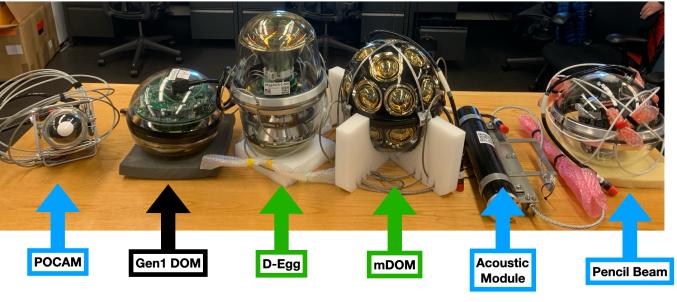
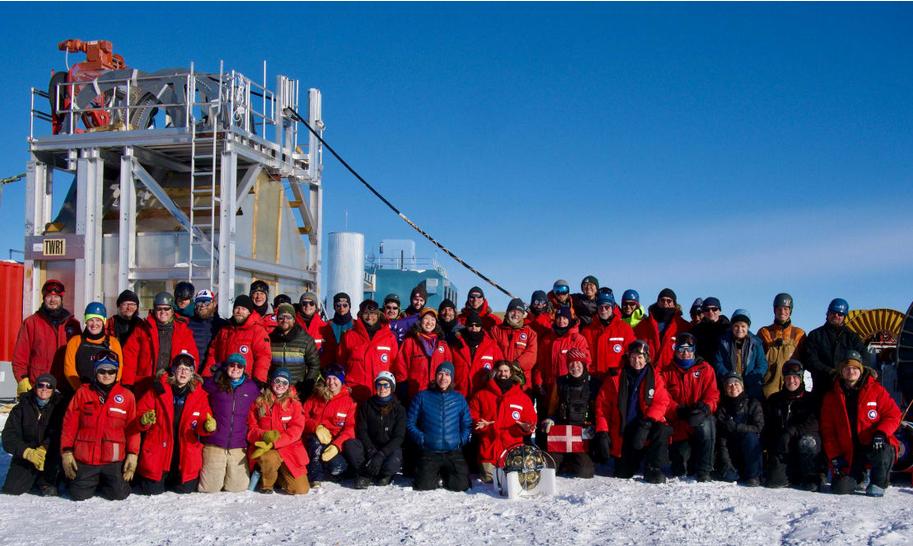
Five of the six deployed Upgrade string are taking data. At March 11, communication with string 87 (the first of the six strings deployed) was lost. Diagnostic measurements indicate a cable break at a depth of around 700 m. As a result, all modules on the string are unresponsive, and the string is not currently expected to return to operation. Actually, during the drilling of string 87, the drill remained at a depth of around 680 m for an extended period, creating a wider hole at that depth. This led to slower and different refreezing conditions compared to the other holes — one of the possible hypotheses, with a straight impact on future deployments. Such a failure has never happened in IceCube. The incident is under investigation, including steps to prevent this kind of failure from occurring again.
There is no impact on understanding the performance of the new optical modules and on the study of ice properties, since string 87 did not comprise any device which is not also present along other strings. Based on preliminary indications, one expects the impact on low-energy event rates to be modest.
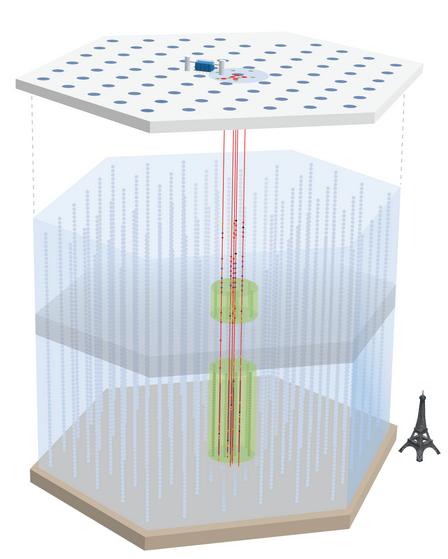
Here is the actual configuration of IceCube, with the five operating new strings in red and the instrumented volume of DeepCore in green.
Gen2: The IceCube-Gen2 project continues to progress through a rigorous, multi-year NSF review process (Major Facility). The project has submitted required documentation and technical plans to the NSF, and is preparing for a review expected later this spring.
Baikal-GVD
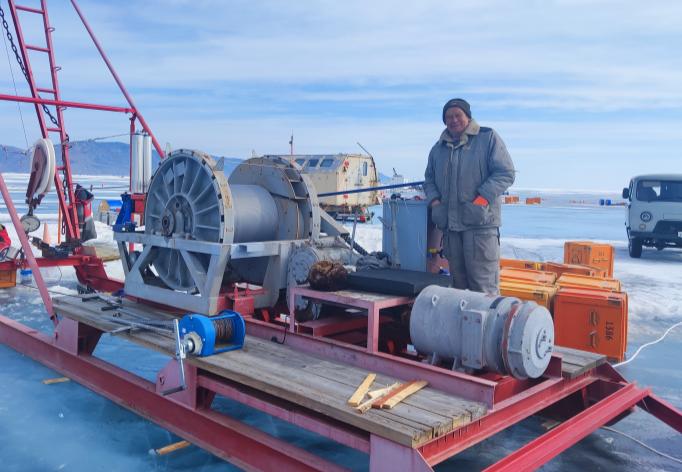
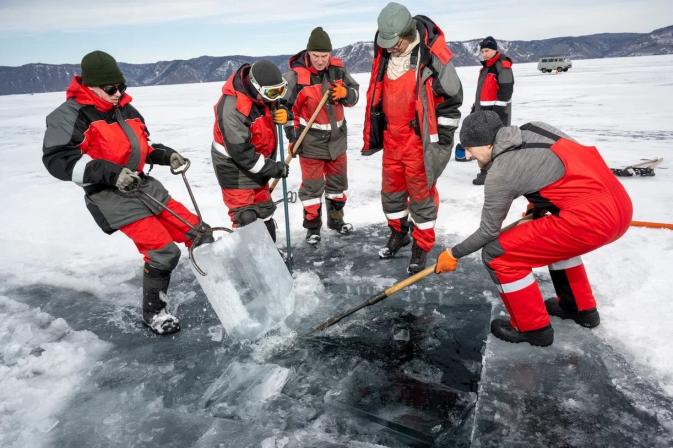
Two new clusters have been deployed this season, so that GVD now comprises 16 clusters in total. Both clusters contain the nominal 8 strings plus one “external” string to fill the room between the clusters. These new clusters are connected to shore via a double-headed electro-optical cable which was laid also this season. Last but not least, two Chinese test strings with a total of 42 OMs have been deployed.
Here are some photos from the expedition:
P-ONE
After the successful 2024 Straw-b expedition, the focus has shifted to data analysis and planning the next steps towards the P-ONE neutrino telescope. Several internal reviews have been completed and preparations for future deployments continue. The collaboration is also exploring synergies with other ocean-based infrastructure projects in the Cascadia Basin region and noise rates.
KM3NeT
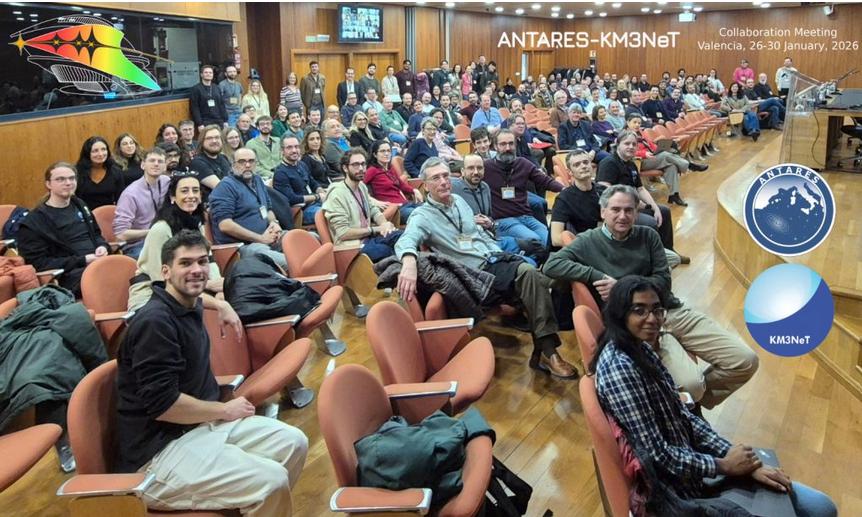
Collaboration Meeting: End of January, The KM3NeT Collaboration gathered in Valencia, Spain, for the first Collaboration Meeting of 2026. During the meeting, the KM3NeT Collaboration welcomed the Ruhr-Universität Bochum (Germany) and the University of Turku (Finland), with research teams led respectively by Anna Franckoviak and Elina Lindfors, as newest observer institutes.
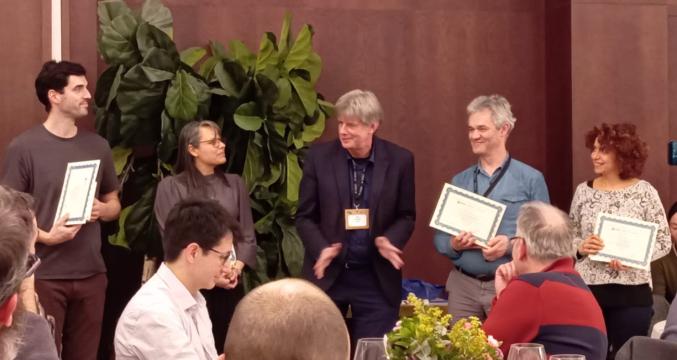
Additionally, the Valencia meeting saw the announcement of the latest winners of the Giorgos Androulakis Prize, which is assigned for recognizing exceptional dedication and achievements by early-career scientists and technicians and engineers: Alfonso Garcia Soto, Lizeth Morales Gallegos, Alexander Enzenhöfer and Irene Sgura (see the webpage for details).
KM3NeT – ARCA
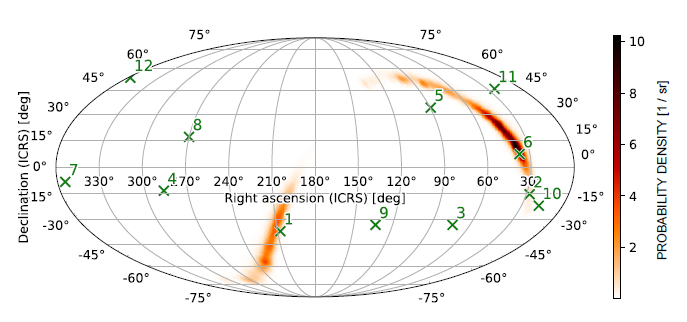
ARCA: The “Nautilus” funding proposal was approved by INFN. It contains a modest number of DUs (aka strings) for ARCA but is important for extension of the underwater infrastructure for ARCA (junction boxes). It funds ARCA sea campaigns, contains funds for an upgrade of the ARCA shore station, and has funds to hire additional staff. A second proposal for adding more DUs is still under review.
At present, 45 of the deployed 51 DUs can be read out and are taking data. Four strings cannot be powered. Two of them are at the edge of the field and are accessible. They will likely be recovered and replaced this summer. The remaining two can be powered. One shows some effects which are not fully understood, the other one just needs a new server at shore.
KM3NeT – ORCA
ORCA: The next ORCA sea campaign is foreseen for April 13-19, depending, as always, on weather conditions. All 33 deployed ORCA strings are taking data.
Masterclasses: In the last March week, the collaboration had the first KM3NeT Masterclasses for high school students, at seven institutes in the collaboration. They follow the concept of the IPPOG masterclasses which are typically focused on working with LHC data. For these masterclasses students classified some events from event displays and videos, performed a time calibration (!) and searched for point sources in a data set.
Publications
The IceCube, LIGO and Virgo collaborations have posted a paper Deep Search for Joint Sources of Gravitational Waves and High-Energy Neutrinos with IceCube During the Third Observing Run of LIGO and Virgo at https://arxiv.org/pdf/2601.07595. Main authors are Zsusza Márka, Doga Veske and Albert Zhang (Columbia Univ., NY).
Including sub-threshold events, they searched for common sources of gravitational waves and high-energy neutrinos. The search did not identify significant joint sources. The results constrain the isotropic neutrino emission from gravitational-wave sources for very high values of the total energy emitted in neutrinos (> 10⁵²–10⁵⁴ erg).
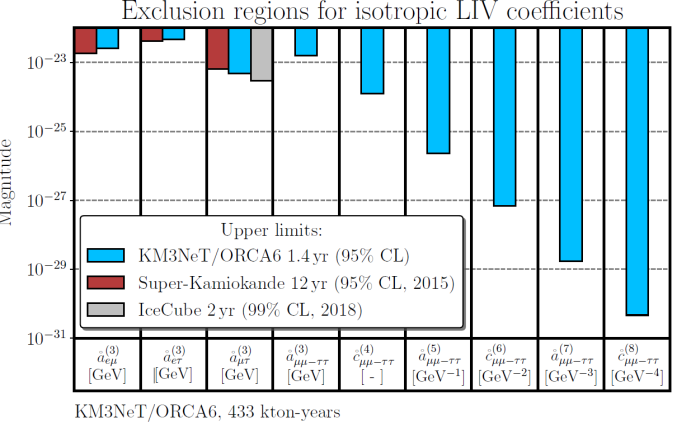
The KM3NeT collaboration has posted a paper Atmospheric neutrino constraints on Lorentz invariance violation with the first six detection units of KM3NeT/ORCA at https://arxiv.org/pdf/2603.04264. Main authors are Lukas Henning and Alba Domi (both University Erlangen).
The paper presents a search for isotropic Lorentz invariance violation with 1.4 years of atmospheric neutrino data collected by a partial configuration of the KM3NeT/ORCA detector. No evidence for such a violation is found; thus, competitive limits are set on isotropic Lorentz invariance violating coefficients, which complement and extend existing experimental constraints.
The Baikal-GVD collaboration has posted a paper First constraints on point-like astrophysical sources using Baikal-GVD muon neutrino events at https://arxiv.org/pdf/2603.21261. Main authors are Evgenii Bondarev and Dmitry Zaborov (both INR Moscow).
The analysis uses track-like events collected between April 2019 and March 2024 (total live time of about 30 cluster-years equivalent to 1.5 km³-years) to search for muon neutrino fluxes from a list of 92 astrophysical objects of interest. No significant excess has been found, so upper limits are reported. The obtained limits are of the same order as those set by ANTARES and KM3NeT. The authors note that the sensitivity at present has an uncertainty of ±35%.
Miscellaneous
Francis Halzen has won the APS Medal for Exceptional Achievement in Research, the American Physical Society’s highest honor. It is for his work in neutrino astrophysics, and especially his “leadership of the IceCube Neutrino Observatory, and the discovery of high-energy astrophysical neutrinos and their sources”. See https://www.youtube.com/watch?v=lYwzUmEougc
Julia Tjus, professor of theoretical physics at Ruhr University Bochum (Germany), associate principal investigator at the Lamarr Institute for Machine Learning and Artificial Intelligence and member of the IceCube collaboration, has been elected as an international member of the Royal Swedish Academy of Sciences (KVA). This membership recognizes her internationally acclaimed research at the intersection of astroparticle physics and AI. The Royal Swedish Academy of Sciences has only 175 seats for international members, all of whom are elected for life.
Upcoming Conferences
- MACROS 2026, Penn State, April 23–24
- GNN Meeting, Amsterdam, May 25–26
- ICRC, Geneva, July 18–25
- ICHEP, Vienna, July 27–30
- TeVPA, Hamilton, August 25–29