
104th Edition — April 28, 2026
GNN Meeting in Amsterdam
The program of the GNN Meeting is taking shape. As of April 28, 74 participants have registered. Presently, the full list of participants seems to be visible only to registered people. This is going to be corrected, with the participant’s consent. As far as I can judge from the list, IceCube participation is still a bit on the low side.
See more under https://indico.nikhef.nl/event/7529/.
News from the experiments
IceCube
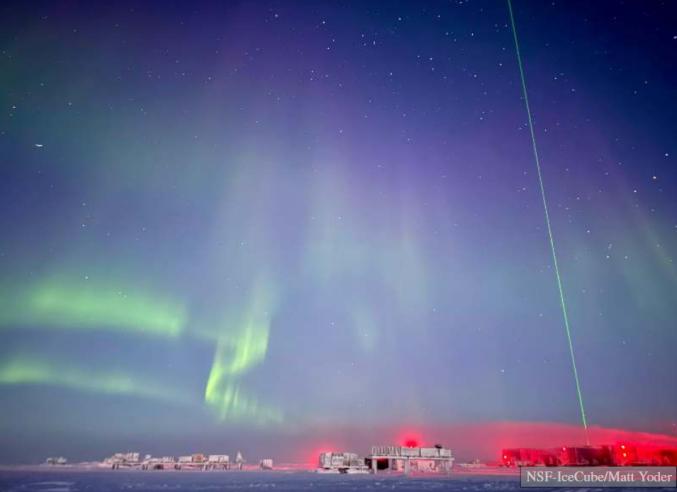
Nothing new from IceCube. Commissioning of the Upgrade is ongoing. Below an iPhone picture showing the station, a laser beam for atmosphere study and an aurora.
KM3NeT
Welcome, ORCA-38!
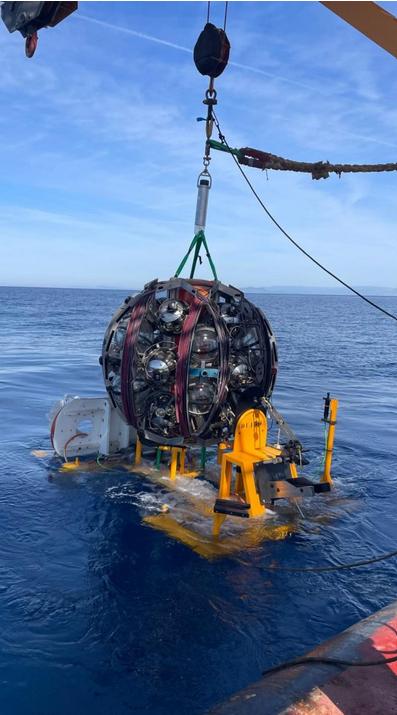
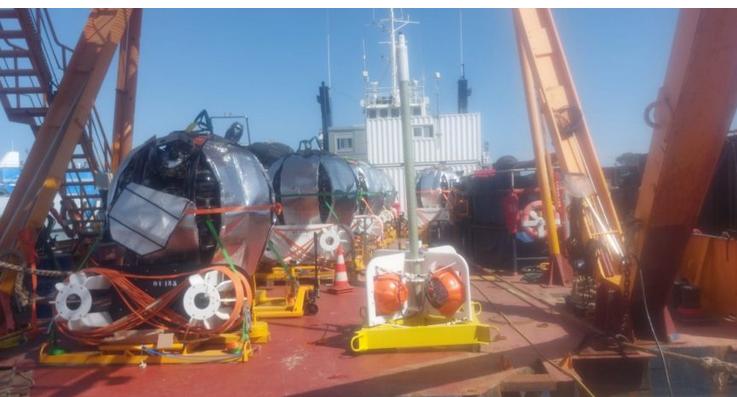
In a successful four-day sea operation in good sea conditions, five new detection units were installed. In addition, a new tripod hosting an acoustic emitter to be used for positioning purposes was installed and the subsidiary battery of the submarine node was recharged (a maintenance operation which has to be performed every few years). At the end of the operation, the apparatus comprises 38 detection units.
As usual, the operation was performed with two ships: the Castor 02 of Foselev, for deployment of the detection units, and the Janus II of SAAS (formerly Comex), equipped with the Apache deep-sea remotely operated vehicle (ROV), for submarine operations.
First call opened for transnational access to KM3NeT and Auger data
For the first time, the KM3NeT and Pierre Auger Collaborations encourages external scientists to propose scientific programs using their data, via a transnational access call. Following proposal submission, the Program Committee (PC) will evaluate proposals, with this cycle’s review conducted by a joint KM3NeT+Pierre Auger PC. This includes several members from both KM3NeT and the Pierre Auger Collaborations as well as from other related experiments.
The cycle 1 of transnational access to KM3NeT and/or Auger data is opened up to the submission deadline: May 22, 2026, at 12:00 UTC. The decision will be given early September.
You can find the details of both calls on their respective pages:
https://www.km3net.org/first-call-opened-for-transnational-access-to-km3net-data/
https://www.auger.org/news/news/358-tna-cycle1
This call is supported by the ACME project (https://www.acme-astro.eu/) that enables transnational access on the basis of scientific merit to a wide range of complementary astroparticle, high-energy and astronomical research infrastructures to perform new science in multi-messenger astrophysics.
RNO-G
RNO-G is rather busy meeting several shipping deadlines to Greenland within the next month so that installation can continue in the small window between mid June and mid August.
Baikal GVD
Work in the ice camp ended few days earlier than usual due to the lack of snow on the ice. In the second half of the expedition bright sun and warm weather changed the structure of ice, weakening its load-bearing capacity. More than 70 people participated in the expedition.
Both new clusters plus three inter-cluster strings with calibration lasers are fully operational and included in data taking in a fairly normal way.
Publications
The P-ONE collaboration has submitted a paper Optical calibration systems of the Pacific Ocean Neutrino Experiment to JINST (posted at https://arxiv.org/pdf/2603.09495). The corresponding authors are Felix Henningsen (FAU Erlangen) and Jakub Stachu (Simon Frazer U., Canada).
Abstract: This work presents the design and performance characterization of the optical calibration systems produced for the Pacific Ocean Neutrino Experiment (P-ONE). These include novel light-pulse driver circuitry based on gallium nitride field-effect transistor technology and its application to directional and isotropic, self-monitoring optical calibration instruments. A total of 330 directional light pulsers and two isotropic, 17-inch calibration modules (P-CALs) were produced for the first P-ONE line. We present the designs and performance of both the directional and isotropic calibration devices and perform detailed optical characterizations of both full-production batches. In a wavelength range of 365–520 nm, our developed driver circuits achieve emission intensities up to 1011 photons and pulse widths as small as 1.4 ns, respectively. Light-pulse drivers and self-monitoring electronics in the P-CAL were characterized using the same experimental setup, and the instrument’s optical-isotropy design was optimized in combination with a dedicated GEANT4-based simulation framework. The optimized P-CAL achieves a simulated isotropy grade of 1.00±0.01 across the entire 4π solid angle range. These simulation investigations were explicitly confirmed by dedicated measurements in both air and water using two independent experimental setups, and we report the results. With this, a detailed performance estimate for deployed P-CAL modules in P-ONE was possible.
See the following figures for illustration and the paper itself for explanation and for the results obtained from the test.
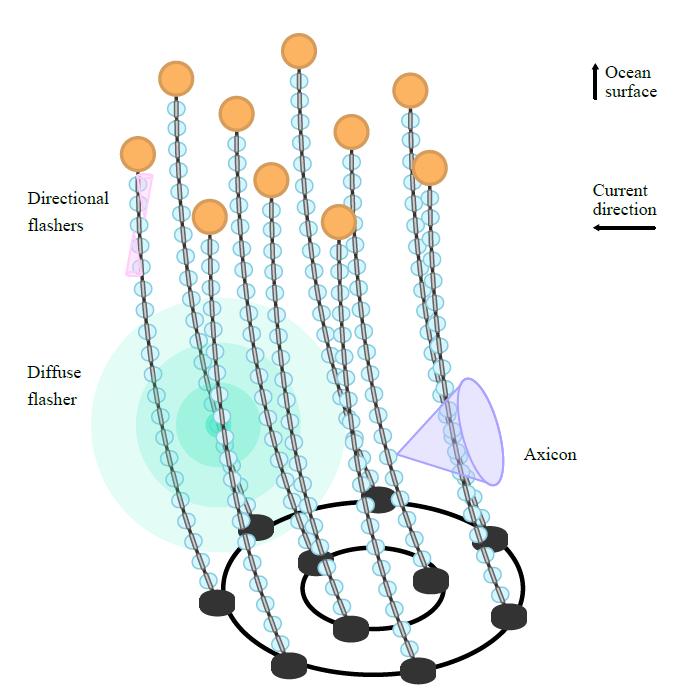
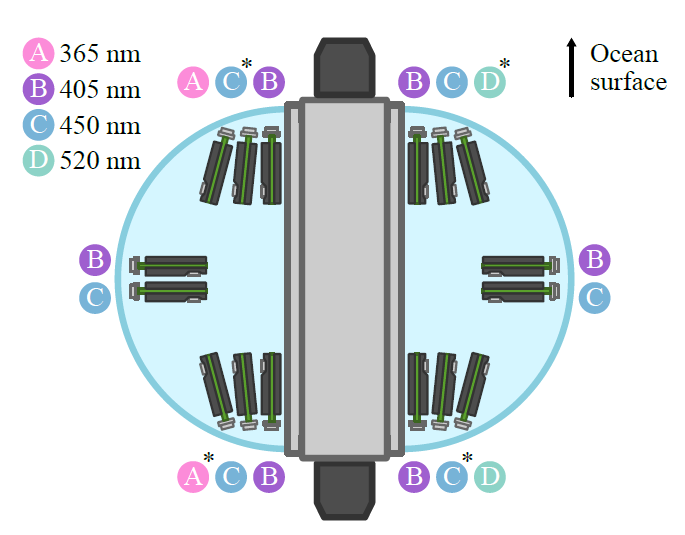
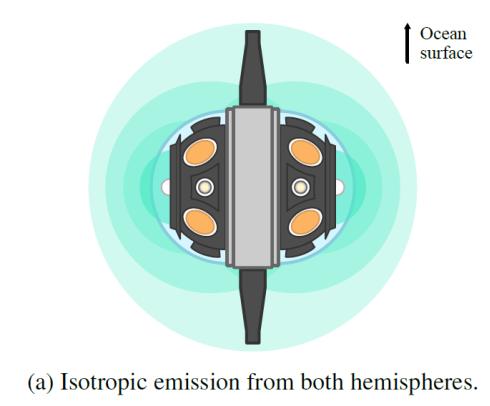
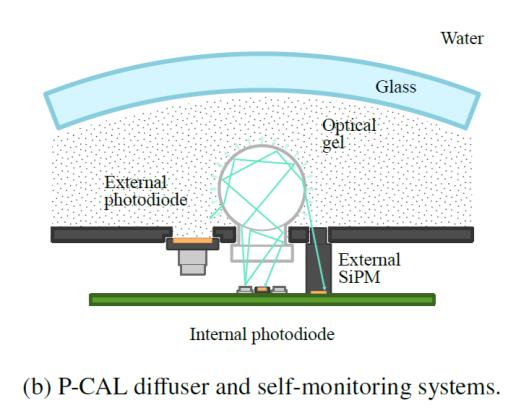
Visualizations of the P-CAL in P-ONE. Shown are (a) the full, isotropic emission and (b) a detailed view of the isotropic flasher and self-monitoring concept.
The IceCube Collaboration has posted a paper Neural posterior estimation of the neutrino direction in IceCube using transformer-encoded normalizing flows on the sphere at https://arxiv.org/pdf/2604.19846. Main author is Thorsten Glüsenkamp (Stockholm Univ.).
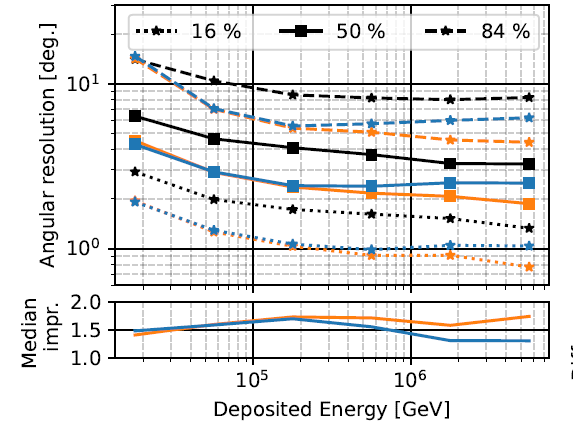
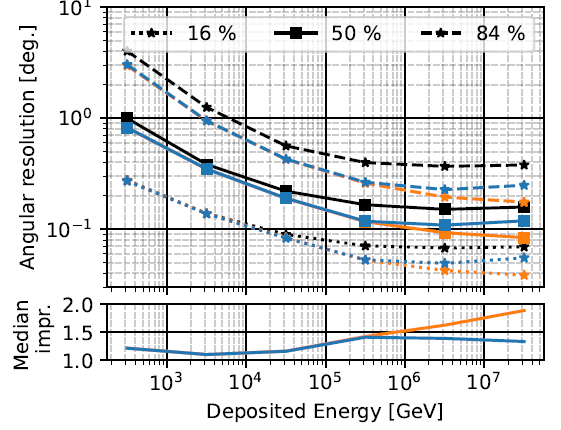
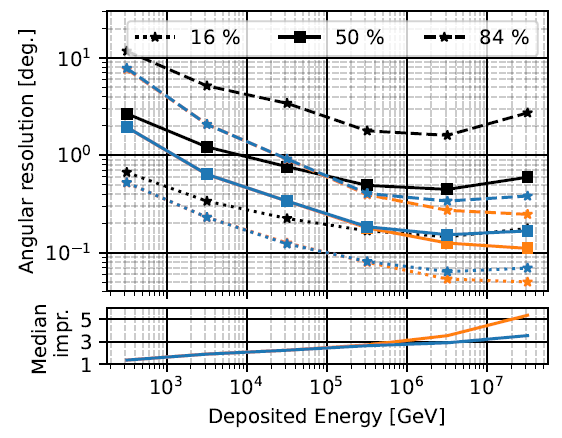
Abstract: …we discuss neural posterior estimation of the neutrino direction via a transformer encoder that maps to a normalizing flow on the 2-sphere. It achieves a new state-of-the-art angular resolution for the two main event morphologies in IceCube – tracks and showers – while being significantly faster than traditional B-spline-based likelihood reconstructions. All-sky scans can be performed within seconds rather than hours, and take constant computation time, regardless of whether the posterior extent is arc-minutes or spans the whole sky. We utilize a combination of C2-smooth rational-quadratic splines, scale transformations and rotations to define a novel spherical normalizing-flow distribution whose parameters are predicted as a whole as the output of the transformer encoder. We test several structural choices diverting from the vanilla transformer architecture. In particular, we find dual residual streams, nonlinear QKV projection and a separate class token with its own cross-attention processing to boost test-time performance. The angular resolution for both showers and tracks improves substantially over the whole trained energy range from 100 GeV to 100 PeV. At 100 TeV deposited energy, for example, the median angular resolution improves by a factor of 1.3 for throughgoing tracks, by a factor of 1.7 for showers and by a factor of 2.5 for starting tracks compared to state-of-the art likelihood reconstructions based on B-splines. While previous machine-learning (ML) efforts have managed to obtain competitive shower resolutions, this is the first time an ML-based method outperforms likelihood-based muon reconstructions above 100 GeV.
The figures next column show the improvement of the median angular resolution of the new method (16%, 50%, 84% quantiles) of the new method (“transformer normalizing flow, TNF”) with and without saturated DOMs compared to the state-of-the-art respective likelihood method based on B-splines, SplineMPEMax for tracks and Taupede2024 for showers.
Impressum
GNN Monthly is the Monthly Newsletter of the Global Neutrino Network
https://www.globalneutrinonetwork.org
Editor: Christian Spiering, for the GNN Board
christian.spiering@desy.de