
106th Edition — June 25, 2026
GNN Dissertation Prize 2026
The 2026 GNN Dissertation Prize was awarded to three recipients:
Tetiana (“Tania”) Kozynets for her thesis Atmospheric neutrino oscillations in IceCube-DeepCore within and beyond the unitary framework
Affiliation at the time of defense: Niels Bohr Institute, University of Copenhagen. Present affiliation: Department of Mathematical Sciences, University of Liverpool.

Tania’s thesis work was focused on tau neutrino appearance oscillation with IceCube as well as global fits to test for (non)unitarity in the neutrino oscillation sector. The committee appreciates the “really excellent work” and “especially the multiple approaches to the problem”. The reviewers also pointed out that the thesis is “pedagogically excellent” and “innovative” and provided an “original strategy in studying unitarity of neutrino mixing”. It had “very significant impact on the analyses of the Deep-Core data”.
Alfonso Lazo Pedrajas for his thesis Neutrino oscillations and search for Non-Standard Neutrino Interactions with KM3NeT/ORCA
Affiliation at the time of the defense: IFIC-University of Valencia, working with KM3NeT. Current affiliation: IIHE-Université Libre de Bruxelles, working with JUNO

Alfonso’s thesis work investigates atmospheric neutrinos detected by the KM3NeT/ORCA detector to measure neutrino oscillation parameters and to search for possible Non-Standard Neutrino Interactions (NSI). It is “a really high-quality body of work” with “real contributions to both high- level and low-level analysis” and reviewers were “impressed throughout”. Both the “introduction and the analysis part are very well structured” and the “statistical data analysis section is very complete” and very well described.
Francesco Benfenati Gualandi for his thesis The KM3NeT experiment: methods for Time, Position and Pointing Calibration of the Detector.
Affiliation at the time of defense: University of Bologna/ Istituto Nazionale di Fisica Nucleare. Current affiliation: Istituto Nazionale di Fisica Nucleare/Bologna

Francesco’s thesis work was focused on methods for time, position and pointing calibration of the KM3NeT detector. The committee mentioned that this ‘Incredibly impressive” thesis – “a tour de force” – studied “timing and position calibration in detail, and [was] done well in a challenging environment”. Studying the moon shadow in addition to everything else, it goes into “into very technical matters, but does so in a very clear and concise way, without loss of accuracy or specificity”. Francesco shows a “strong technical understanding”.
Congratulations to all three winners!
News from the projects
KM3NeT
(submitted by Damien Dornic)
Mid-June, the KM3NeT Collaboration gathered in Bratislava for the Summer Analysis Collaboration Meeting. It was an intense and productive week, marked by significant analysis progress and key decisions concerning the upcoming summer results. Data taking continues successfully with ORCA-38 and ARCA-51, while important analysis milestones were achieved with the approval of the ORCA-6-18 oscillation, tau neutrino production, and sterile neutrino analyses. Different hands-on sessions focused on the migration to Rucio data management for distributed computing data quality and data processing, and substantial progress was made toward quasi-online calibration, enabling faster feedback on data quality.
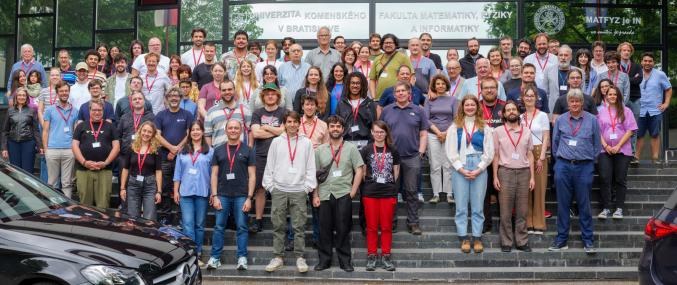
The collaboration also welcomed two new full member institutes: the Slovak Academy of Sciences and the University of Würzburg.
In parallel, the Collaboration is actively preparing its next two sea campaigns: an ORCA campaign in early July, expected to deploy 4–5 Detection Units (DUs), and an ARCA campaign in early September, planned to deploy 12 DUs, 2 jonction boxes, and additional acoustic sensors (for the absolute pointing).
P-ONE
(submitted by Matthias Danninger)
Mid of June, the P-ONE collaboration met at the University of Alberta in Edmonton, Canada, joined by key representatives from Ocean Networks Canada and MacArtney Denmark. The agenda covered lessons learned from constructing the first detector line, P-ONE-1, finalized plans for its testing and deployment later this year, and the status of the next construction phase, the P-ONE Demonstrator. The collaboration also initiated the concrete roadmapping phase toward a full-scale experiment, marking the start of formal planning for these future stages.
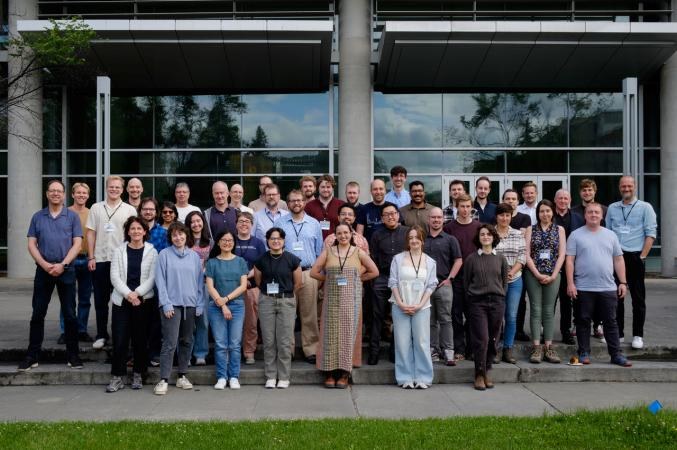
The meeting was highly productive, and the collaboration is energized for a pivotal summer ahead. First up: the final pre-deployment shallow-water wet test, scheduled for the last week of June in Vancouver.
RNO-G
(submitted by Anna Nelles)
RNO-G has started the new installation season: On June 14th, the first RNO-G team members arrived at Summit Station in Greenland, ready to kick-off the installation season.
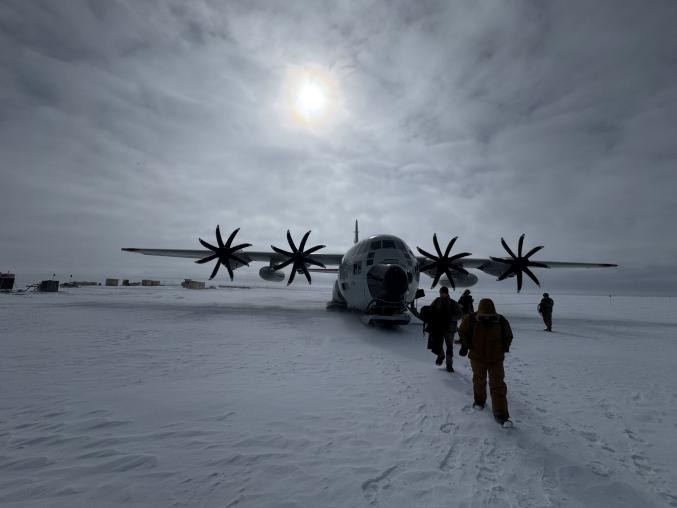
As every year, first the drill will be rebuilt and drilling will start. With a head-start of around 4 weeks, drilling is then followed by the planned installation of new stations and maintenance of the old stations, which will include a new set of wind-turbines and refurbishment of station electronics. Installation is projected to last until August, when the season at Summit Station ends.
This year will deal with new flight plans as Kangerlussuaq is no longer the main destination of Air Greenland and mid-season personnel exchange will take place via Iceland. Also, Summit Station undergoes significant upgrading, which will make the station exceptionally full. Expect an update about the installation progress after the busy summer.
IceCube
May 18–22, 2026, the IceCube Collaboration gathered at Ruhr-Universität Bochum (Bochum, Germany) for their spring collaboration meeting.
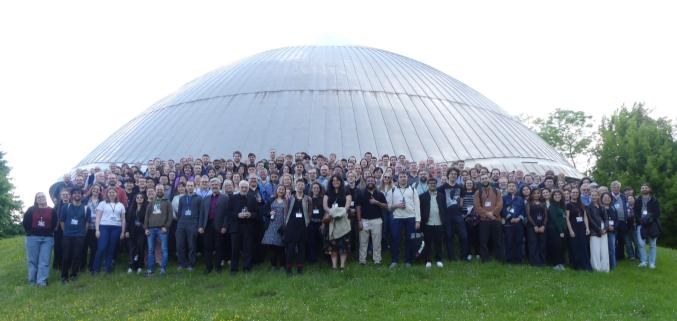
During the meeting, the collaboration welcomed two new (personal) associate members: Aaron Vincent, Queen’s University (Kingston, Canada) and Doğa Verske from Middle East Technical University (Ankara, Turkey).
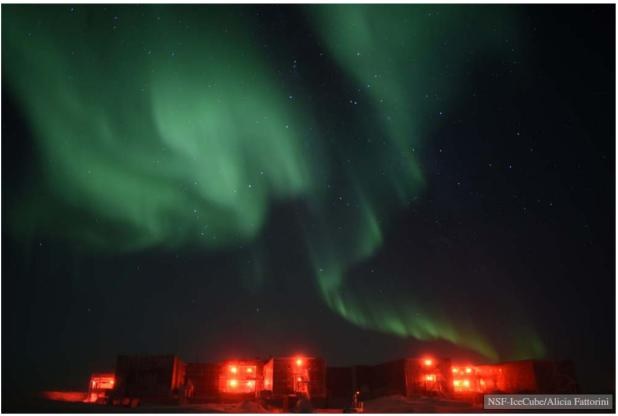
Work at South Pole is running smoothly, while nature gives the winterovers fascinating auroras (photo: Alicia Fattorini).
Baikal-GVD
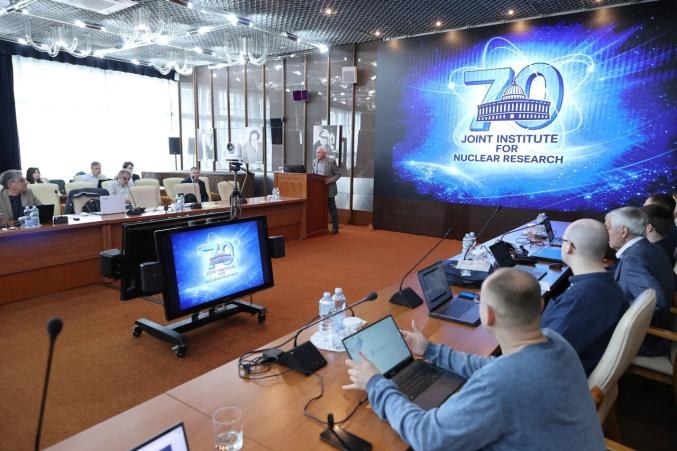
June 1-5, the Baikal-GVD Collaboration met for their spring collaboration meeting in Dubna. There is no group photo, instead see a view to the conference hall:
GNN Meeting
(submitted by Claudio Kopper)
The Global Neutrino Network (GNN) aims for a closer collaboration and a coherent strategy among the neutrino telescope projects. As part of this goal, GNN has been organizing meetings, formerly called “MANTS”, now just called the “GNN Meeting”.
On May 25 and 26, members from all GNN collaborations came together at NIKHEF, Amsterdam, for the most recent iteration of the GNN Meeting.
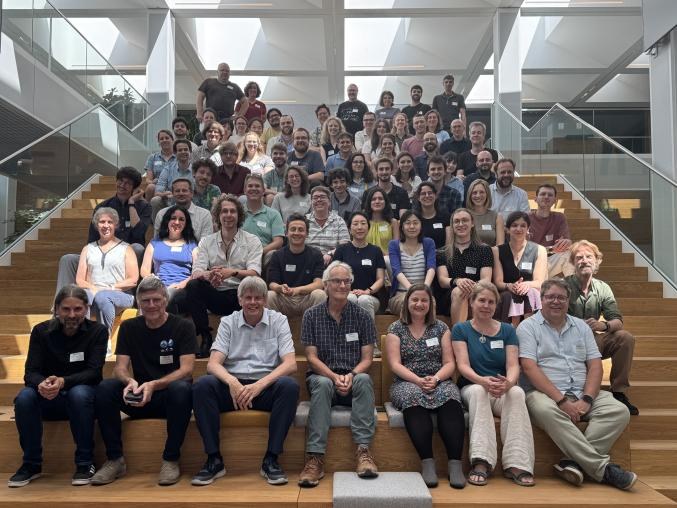
For two days, we had updates and introductions from new members, presentations on various topics, such as new detector concepts, analysis and likelihood tools, high-level data analysis results, calibrations, flux modeling, and real-time data formats. We also presented the names of the winners of the GNN Dissertation Prize to the GNN community (see above).
A wide range of members from all collaborations attended the meeting in person, and thanks to our hosts at NIKHEF, the Zoom connection worked really well (making it possible for remote participants to even join discussions!).
Particularly well-received was the “unconference” format that started with free-form topic pitches on day 1 and then break-out discussions on day 2 followed by summaries to all of the participants in plenary. Topics such as AI tools, sustainability, likelihood tools, NMO analysis, GNN usefulness, galactic neutrino fluxes, and real-time alerts were discussed.
All information and slides can be found at https://indico.nikhef.nl/event/7529/timetable/#20260526 (password: “GNN2026”). In order to foster communication, we also started a GNN Slack team https://join.slack.com/t/gnnglobalneut-6rn2692/shared_invite/zt-3yzreyxqd-XzGqiq9H6bzz2xhXr_9YDQ. GNN rules on confidentiality apply there as usual, and it should be considered a test run for now – we might change the chat service in the future, for example.
Finally, there is a call for bottoms-up GNN working groups to be established (or the existing ones to be more formalized). If you are interested in making any of the groups “official”, let the GNN board chairs (Paschal and Claudio) know. We can then announce these working groups in a GNN monthly issue, on the GNN Slack, and, of course, the GNN web pages.
Publications
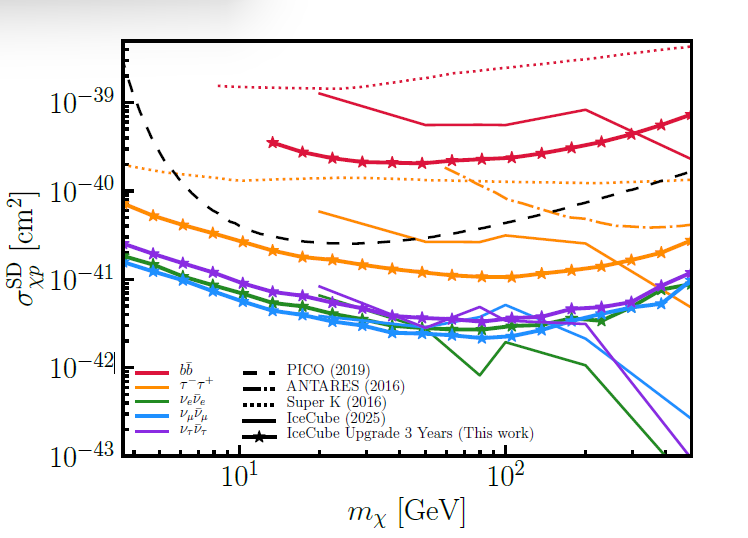
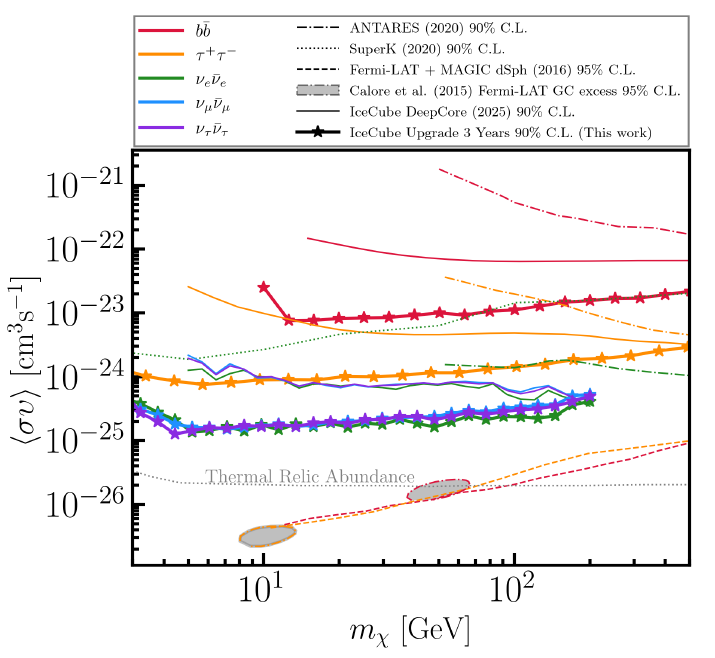
The IceCube Collaboration has submitted a paper Sensitivity Projections for Low-Mass Dark Matter Annihilation with the IceCube Upgrade to JCAP (posted at https://arxiv.org/pdf/2605.06600). Main authors are Eliot Genton, Nhan Chau (ULB Brussels and Jeffrey Lazar (UC Louvain).
Abstract: The IceCube Upgrade […] will markedly improve IceCube’s sensitivity to low-mass dark matter scenarios. In this study, we present sensitivity projections for the IceCube Upgrade to neutrino fluxes arising from dark matter annihilation […] We consider dark matter with masses between 3 GeV to 500 GeV from both the core of the Sun and the Galactic Center. These projections indicate that the IceCube Upgrade will enable stringent limits on dark matter in this parameter space, achieving leading sensitivities to some dark matter models with only three years of data taking.
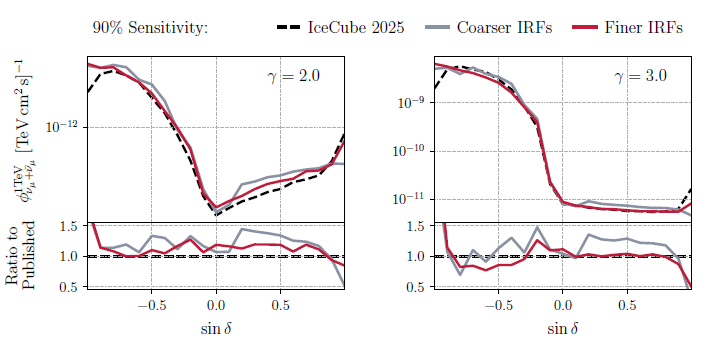
The IceCube Collaboration has submitted a paper IceCube Second Track Data Release IceTracks-DR2: Data from 2008-2022 for Neutrino Source Searches to ApJ (posted at https://arxiv.org/pdf/2605.19040). Main authors are William Luszczak, Chiara Bellenghi, Jose Carpio, Riya Shah, Tomas Kontrimas.
Abstract: We present IceCube’s latest release of muon track data for neutrino point-source searches, extending the previously published 10-year dataset to cover 14 years of observations (April 6, 2008 – May 23, 2022). This release features an updated event selection and improved detector calibration for data recorded after June 1, 2010. The release also includes binned instrument response functions and effective areas, enabling the community to perform sensitive searches for steady and transient neutrino sources. We report on key science results obtained with this dataset using internal IceCube analysis tools and compare them to those derived from analyses based on the binned response functions included in this public release. To facilitate reproducible research, we provide benchmark results obtained using this data release and publicly available software. This release represents IceCube’s most sensitive and comprehensive publicly available all-sky muon track dataset to date and should be preferred over previous releases.
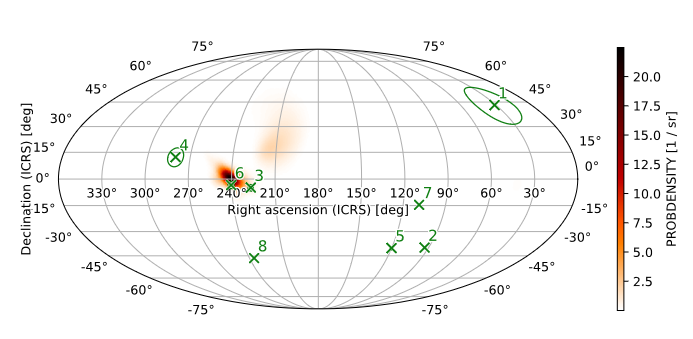
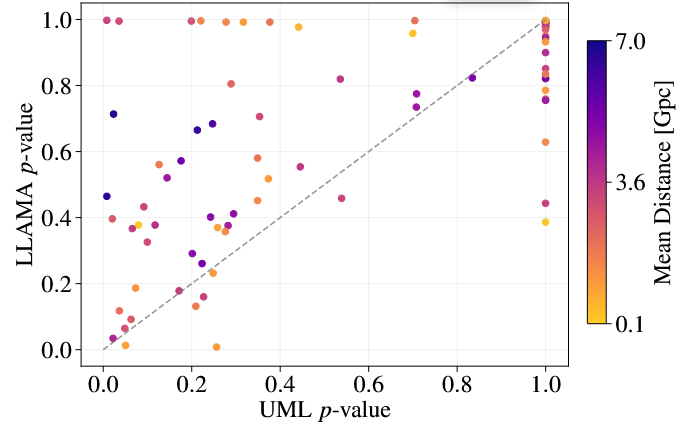
The IceCube collaboration has submitted a paper IceCube Real-time Searches for High-energy Neutrinos Coincident with LIGO/Virgo/KAGRA Gravitational-Wave Alerts in O4a to ApJ (posted at https://arxiv.org/pdf/2606.13762). Lead authors are Jessie Thwaites (UW/Queens) and Doğa Veske (UW).
Abstract: …Using data from the IceCube Neutrino Observatory, we search for neutrinos coincident with 85 significant and 945 low-significance gravitational-wave candidate events from compact binary coalescences published in real-time by the LIGO-Virgo-KAGRA collaboration during the first part of its fourth observing run (O4a) and its preceding engineering run, within a time window of ±500 seconds centered on the merger time. We report improvements to the online pipelines, including automatic sending of notices, which has decreased the IceCube real-time response time to gravitational-wave events. In addition, we search for long-duration neutrino emission (up to two weeks after the merger) from three candidate events: two neutron star – black hole mergers, and one low-significance gravitational-wave event with a possible subthreshold gamma-ray counterpart. We use two methods, both of which have been previously used to search for neutrino emission associated with gravitational-wave transients: an unbinned maximum likelihood analysis on significant alerts and a Bayesian analysis accounting for astrophysical priors on both significant and low-significance alerts. We find no statistically significant emission from any of the individual gravitational-wave events analyzed, and set upper limits on the time-integrated flux and energy emitted in high energy neutrinos assuming isotropic emission from each event.
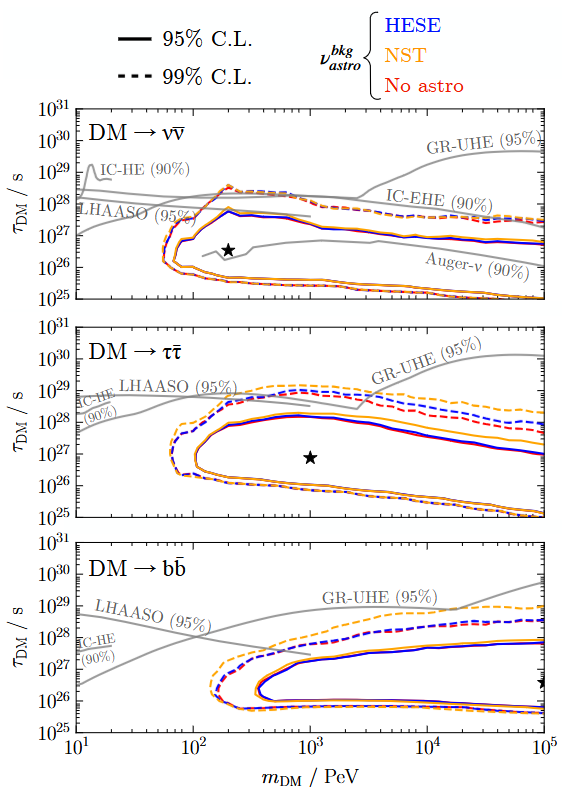
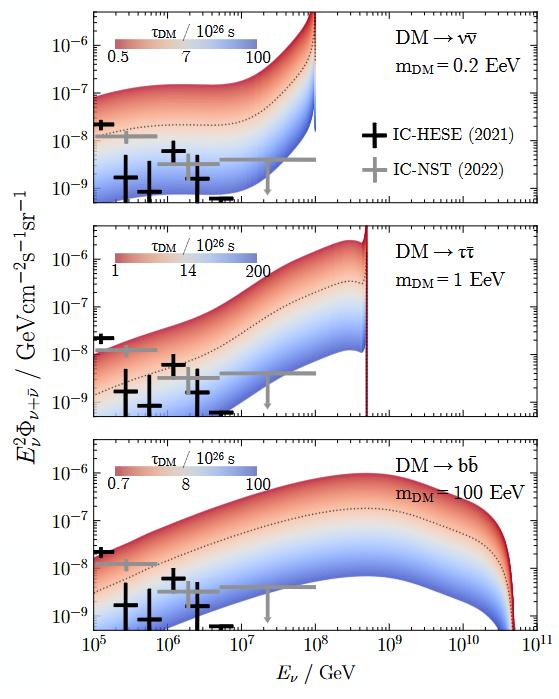
The KM3NeT Collaboration has posted a paper Testing Heavy Dark Matter Decay as the Origin of KM3-230213A at https://arxiv.org/pdf/2606.09986 and submitted to JCAP. Corresponding authors are Rebecca Gozzini, Alfonso Garcia Soto and Marco Chianese (all IFIC València).
Abstract: This work explores the hypothesis that the ultra–high-energy neutrino event KM3-230213A originates from the decay of a heavy dark matter particle with a mass above PeV scale. The analysis exploits the deposited energy and arrival direction of the event as well as a complete detector Monte Carlo simulation to compute the expected signal distributions for different decay channels and assesses the relative contributions from Galactic and extragalactic dark matter. Assuming a dark matter origin of the event, we find that the preferred mass mDM at 95% C.L. is larger than about 100 PeV in all scenarios considered, with best-fit lifetimes τDM in the range 10²⁶–10²⁷ s. These preferred regions are in tension with existing bounds from other neutrino telescopes and gamma-ray observations.
Impressum
GNN Monthly is the Monthly Newsletter of the Global Neutrino Network
https://www.globalneutrinonetwork.org
Editor: Christian Spiering, for the GNN Board
christian.spiering@desy.de